


A Trajectory to Unsuffocation performance
The unshackling of societal and cultural suffocation forms the narrative of this performance and large scale painting. While autobiographical, it depicts the universal human struggle for personal liberation. Being true to yourself and daring to live it regardless of expectations and judgements of others. Embracing life!
Filming: Ed Borgnis, Bloomsbury Festival
Somatics is part of my practice. In the creation of this piece I drew on my Iyengar yoga practice as well as esoteric movement method 5Rhythms. I’m fascinated by how our body poses (subconsciously) express our emotions and state of mind. I tell my story through a sequence of specific body poses, which form the composition of this 6x3m painting. From trodden-down figure to full spiritual awakening.
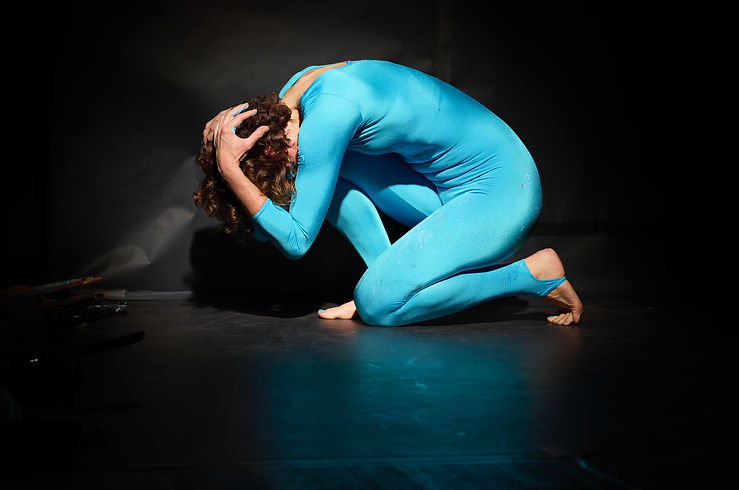
Gwendolyn Kassenaar crouched down Photo: Chris Freeman
Through playful experimentation with dancer Petra Haller, we discovered our own unique way to merge live painting and contemporary dance into one interdisciplinary performance. Furthermore choreographer Yanaëlle Thiran guided me to express my narrative ideas through movement on stage.

Gwendolyn defensive pose traced by Petra Photo: Chris Freeman

Gwendolyn traces Petra in balancing pose Photo: Chris Freeman
I created the colour palette beforehand, aided by my synaesthesia (chromosthesia) as I see the piano sound as light blue ribbons in my mind’s eye. Our bodysuits, each in a colour of my palette, transform us into continuously shifting moving bodies within the painting’s frame, becoming part of the painting during the performance.

Dancer Petra Haller with Gwendolyn Kassenaar paining while moving Photo: Chris Freeman
The gestural and embodied painting action is fully improvised as is the dance. While the music was pre-recorded, we did not practice to it beforehand to preserve a fresh improvisation.

Gwendolyn Kassenaar Endpose Awakening Photo: Stuart Keegan
I am grateful to the deeply engaged audience for their overwhelmingly positive feedback and thoughtful questions in our live Q&A afterwards. See selected testimonials below.
Credits
Concept & Production - Gwendolyn Kassenaar
Live painting - Gwendolyn Kassenaar
Contemporary Dance - Petra Haller
Music - Meg Morley (piano) & Hannah Marshall (cello)
Music editing - Maurizio Ravalico
Presenter - Fausta Jolly
Movement Director - Yanaëlle Thiran
Filming - Ewan Bruce
Editing - Giacomo Heddle
Photography - Chris Freeman & Stuart Keegan
Stage manager & Lighting - Ed Borgnis (Bloomsbury Festival)
Stage structure - Gwendolyn Kassenaar & Guy Goodbody
Performed as part of the Bloomsbury Festival 2022
Dr. Williams Library, Gorden Square, London
15th October 2022
Generously supported by Ealing Council, Capital Studios and Cass Art
With special thanks to Rosemary Richards, Director Bloomsbury Festival and Guy Goodbody.
Testimonials
Feedback from the audience during our live Q&A following the performance.
‘… if that is the story of a life, the way that you did the outlines of the body initially. They’re like things that we do in our past. Our bodies, the positions we hold, will stay with us, maybe faintly, maybe strongly. I really liked how that past history of ours stayed with us and forms the bigger picture as we go on.’
‘When you were crouching down and then the handprints came up, I found that very moving. And how you echoed that with the white handprints at the end, which went across the painting… The second movement, where you did a chalk circle and you were inside, reminded me very much of Leonardo da Vinci’s Vetruvian Man, where everything connects and then you broke those proportions. I just thought that was wonderful. ‘
‘I was very interested by this idea of seeing and not seeing.’
‘I’m curious about the orange character. I was wondering, as this is autobiographical, whether it is you observing your previous self… The blue personality is consistently, gradually more liberated and exuberant. I wonder whether this is like self-looking, like in some kind of mirror.’
‘…By bringing the dimension of time into a painting I think you bring painting very much closer to music. And the memory of a structural element in music is a very important factor in perceiving the overall narrative of a piece of music, of a composition. So seeing what you have done before, while you are doing the next thing, it absolves a similar function.’

Audience engages with painting up close afterwards Photo: Chris Freeman
For bookings or enquiries, please get in touch.